Published on:

Legal Netlink Alliance

Law Firm Referral Networks

Referral networks may seem like relics in an era dominated by digital marketing, but the right network can still deliver steady, high‑quality work and expand a firm’s reach. After more than 25 years evaluating these groups, I’ve found that their value depends on fundamentals: strong leadership, high‑caliber member firms, and a realistic understanding of the full cost of participation. When those elements align, networks can become reliable engines of referrals, reputation, and professional community. My latest marketing column, in the January/February 2026 issue of ABA Law Practice, suggests Law Firm Referral Networks Make Sense If They Make Cents.

Recently, I’ve had the opportunity to work closely—on behalf of a law firm member—with the Legal Netlink Alliance (LNA), a global association of small and midsize independent law firms. Even in a relatively short time, I’ve watched genuine trust take root and real friendships form among its members. Because the network is intentionally composed of smaller firms and its U.S. conferences are intimate by design, it’s remarkably easy to build meaningful connections. I’ve already met another Rabbi’s kid (like me), a Chicago sports fan who always thinks of me when the Phillies or Eagles are relevant, and even found a lawyer in the Midwest who helped me navigate an unexpected traffic stop—best not to ask.

Published on:

ethics_image-300x200It was once again my privilege to serve as editor for the Ethics edition (December 2025) of the American Bar Association’s Law Practice Today webzine. I’ve had the honor of shepherding the Ethics-themed issue for many years—drawing on my work with ABA Law Practice’s Ethics & Professionalism Committee and my long-standing role on the webzine’s editorial board.

A sincere thank‑you to this month’s outstanding contributors. The issue brings together a thoughtful mix of perspectives on the ethical challenges lawyers face today:

  • Beyond the RPC: Staying Compliant with Your Law Firm’s Marketing Efforts — my article exploring how ethics rules intersect with modern marketing practices.
Published on:

In a digital landscape where attention is currency, law firms are beginning to ask a provocative question: Can influencers drive legal business? My latest marketing column, in the September/October 2025 issue of ABA Law Practice, addresses The Rise of the Influencer in Legal Marketing.

Gone are the days when law firm marketing revolved solely around SEO, pay-per-click campaigns, and carefully crafted blog content. Today, the spotlight is shifting toward social media influencers—individuals with massive followings and the power to shape consumer behavior. As I note, influencer marketing is no longer a novelty; it’s a $10 billion industry projected to keep growing. And while it’s long been a staple in retail and entertainment, its potential in legal services is just beginning to surface.

Shortly after moderating an ABA CLE on the subject of influencers, and having already submitted this column to the magazine editors, I read an interesting article in the Wall Street Journal, These Restaurants, Salons and Workouts Are Free for Hot People—if They Post About Them, that focused on the influencer-targeted social media app, Neon Coat, founded by a model as a way to book entire days of meals and experiences for free, by tying brands and businesses. Unfortunately, I don’t appear to qualify as “hot,” and must grab hard-to-book tables on Open Table by being first when a reservation window opens, but wondering if you could offer up legal services, is an interesting notion. It was highlighted by Jones Walker attorney Kaytie Pickett in a blog post on the firm website.

Published on:

TU_Klein-300x125Temple University’s Klein College of Media and Communication has named Micah Buchdahl—ethics attorney, business development adviser, and longtime advocate for legal marketing and professional education—to its Alumni Board as a Director at Large.

A proud graduate of Klein College, Buchdahl brings decades of experience in strategic communications, ethics compliance, and attorney business development to the board. His appointment reflects a deep and enduring commitment to mentoring future media professionals and giving back to the institution that helped launch his career.

Klein College is nationally recognized for its excellence in journalism, public relations, advertising, media production, and communication strategy. Its alumni community includes trailblazers and thought leaders across industries. As a member of the board, Buchdahl joins a distinguished group of professionals dedicated to expanding that network through strategic initiatives, alumni programming, and career development efforts.

Published on:

morganmorgan-300x200

From The Richmonder/Eleanor Shaw

When Eleanor Shaw, a reporter for The Richmonder, reached out to chat about Morgan & Morgan’s expansion into Richmond, I didn’t hesitate. I’ve been analyzing their disruptive marketing tactics for years, and if you’re even remotely interested in legal advertising (and really, who isn’t?), Morgan & Morgan is the ultimate case study.

Their multi-million-dollar ad blitz is impossible to ignore. Shaw’s article, “You can’t avoid Morgan & Morgan’s multi-million-dollar ad blitz. It’s shaking up Richmond’s legal scene,” offers a comprehensive look at the firm’s entrance into the Richmond market. It explores the ripple effects on local law firms and draws comparisons to how M&M has reshaped legal advertising landscapes in other cities across the country.

Published on:

Morgan-Morgan_Billboard

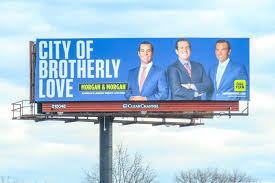
Morgan & Morgan Billboard in Philadelphia

I’ve seen city highways seemingly taken over by lawyers for a long time now. Throughout Nevada, Florida and Arizona, the interstates are littered with promises of fast cash, big cash, and cash in general. I could not begin to tell you which of those attorneys are good or bad—which I guess is part of the point—the consumer selecting counsel off a street sign or a bus is interested in $$$$ and not representative clients or experience in the courtroom (spoiler alert – maybe 50-50?).

For me, though, there is no place like home. And it is on the roads surrounding Philadelphia that brought me the subject for my most recent marketing column, Lawyer Billboard Wars! How Is That Still a Thing? – in the May/June 2025 issue of Law Practice. In an age where almost every spend in law firm marketing is digital, how is it that the billboard is still standing? And not just standing, but thriving? Read on…

Published on:

Charli_Dunkin-275x300

Dunkin Donuts influencer Charli

A few years ago, when my daughter insisted that she needed to try the Charli drink at Dunkin Donuts, I scoffed. Who is Charli? And what is that drink? Well, it turned out “Charli” was social media influencer Charli D’Amelio, with over 100 million TikTok followers, and considered one of the most influential teens in the world. The drink was a sugar-blasted undrinkable concoction (that’s my opinion, and I was not the targeted demographic). The result of that influencer marketing program was (1) the drink sold like hot cakes; and (2) more importantly, it led to a 57% surge in mobile app downloads. Cold Brew sales increased by 20% on the launch day, and 45% on day two. The goal was to appeal to young consumers. It worked. Big time.

As an attorney in the law marketing space, I’ve tried to wrap my head around these newer forms of advertising and promotion. There is no question that influencers influence–Corporate spending on influencers will exceed $10 billion in 2025, more than doubling since 2021, according to eMarketer. Consumer reviews—a cornerstone of marketing for most every industry (law firms included!)—bring their own set of potential perils with them. And creative (and entrepreneurial) digital designers employ dark patterns—deceptive design techniques used in websites, apps, and digital interfaces to manipulate users into making choices they might not otherwise make. In other words, there is lots of room for legal issues and the need for a CLE on the subject matter. This is not your grandparents’ marketing.

Published on:

Attorney ProtectiveOn June 11, 2025, I will be speaking again for the Attorney Protective CLE webinar series, on Brick and Mortar No More: Ethical Issues with Multi-Jurisdictional Lawyering. Last year, more than 2,000 attorneys attended my AttPro program focused on marketing ethics issues, so I’ll “run it back” to delve deeper into the often-related subject of MJP.

As the practice of law has increasingly shifted from being location-based, where the work or client is located becomes the focus. Understanding the Rules of Professional Conduct when working in a multitude of jurisdictions becomes critical to ensure you are in compliance. Micah Buchdahl, founder and president of HTMLawyers, Inc., shares his expertise as to how you can navigate the challenges of virtual law practices and multi-jurisdictional lawyering.  Learn about proposed changes to Rule 5.5 and responses from states and organizations. Kate Gould, Attorney Protective Risk Management Consultant, will join him to discuss recent opinions to help you maximize the versatility of your license.

To learn more about the subject matter, read my related article, The Ethics of Virtual Law Practices and Multi-Jurisdictional Lawyering, from the Spring 2025 AttPro Ally Risk Management Newsletter.

Published on:

fb-lpt-smAuthoring this blog post after serving as an issue editor for the Professional Development edition (February 2025) of the American Bar Association’s Law Practice Today webzine, I suddenly was having a sense of déjà vu. Turns out I was the issue editor of LPT’s multigenerational and multicultural issues nearly 10 years ago, in March 2015. I had little recollection of it. You can even compare what I wrote on the subject matter a decade ago in Law Firm Management Struggles with Multi-Generational Issues. News flash: We’ve been discussing this for well over a decade now.

There is significant overlap between business development and professional development within a law firm. During the four years I chaired the ABA’s Standing Committee on Continuing Legal Education (SCOCLE), and the seven years in total I served on the committee, I was involved with the Professional Development Consortium as well. Every law firm is different in the way they incorporate BD into PD, and at what stage. In a conversation I had recently with a law firm PD professional, she tossed a bunch of enlightening (if not scary) statistics at me regarding incoming attorney classes—how short their stay at the firm will likely be, demands for WFH (look it up, of you don’t know it already), work-life balance, and other “asks” that would’ve ensured I never got a job in an interview when I was getting out of law school (circa early 90s…1990s, not 1890s). But times have changed. I recently read a Law360 article with tips on how associates can thrive in a hybrid work environment…realizing that those “tips” were from a Big Law partner around my age (again 1900s, not 1800s, and certainly not 2000s)…and were what he would do, not necessarily what a young associate might find helpful.

If I’m issue editing the subject another 10 years from now, in 2025, something went drastically wrong with my retirement plans. But it will be interesting to see how things might change, or don’t.

Published on:

ABA Law Practice PodcastIn the January 20, 2025, episode of the American Bar Association’s Law Practice Podcast, host Terrell Turner discusses the complexities of legal marketing with me in this 30-minute discussion available on americanbar.org as well as in your favorite podcast library, including Spotify and Apple.

Micah Buchdahl, who concentrates his practice in marketing, advertising, and solicitation issues at the state bar level, shares his vast experience working with aggressive law firms. The conversation covers the evolution of advertising from print to digital, the impact of changing algorithms on marketing strategies, and the integration of influencers in legal marketing. Micah emphasizes the importance of understanding multi-jurisdictional ethical rules and the responsibility that law firms hold over their marketing practices. This episode provides valuable insights for law firms navigating the rapidly changing landscape of legal advertising.

The Law Practice Podcast is hosted each month by Terrell Turner, the founder of accounting firm, www.TLTurnerGroup.com.

Contact Information